Artificial intelligence
Organizing the Unorganized
AI’s next great opportunity may not be creating intelligence. It may be organizing it.
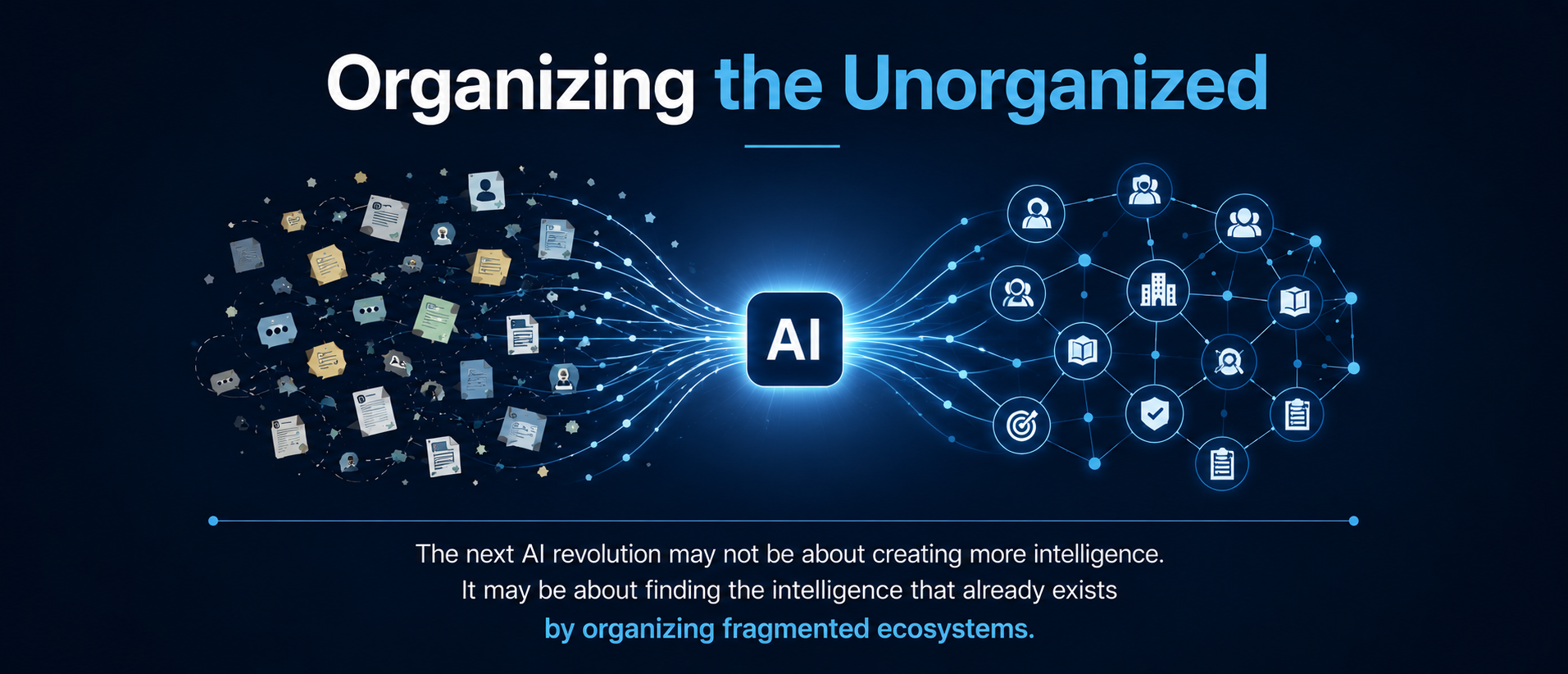
The next AI revolution may not be about creating more intelligence.
It may be about finding the intelligence that already exists.
The world is not short of knowledge.
It is not short of expertise.
It is not short of capability.
What it often lacks is connection.
Every day, valuable expertise remains hidden behind fragmented information, disconnected networks, and informal systems.
The opportunity isn't always to create more.
Sometimes, it's to connect what already exists.
The Absence of Structure
In a previous article, I wrote about fragmentation - how information, context, and capability often exist but remain disconnected.
The same pattern appears at a much larger scale.
Millions of individuals and businesses create value every day.
Yet customers struggle to find them.
Organizations struggle to connect with them.
The problem isn't always the absence of supply.
Often, it's the absence of structure.
Organization as Innovation
Many of the world's most successful platforms solved exactly this problem.
Uber didn't create drivers.
Airbnb didn't create homes.
LinkedIn didn't create professionals.
They organized fragmented ecosystems and reduced the friction of discovery.
Their innovation wasn't invention.
It was organization.
AI's Role in Connecting the Dots
This is where I believe AI introduces a new possibility.
Much of the world's knowledge is still trapped in conversations, documents, local expertise, personal networks, spreadsheets, and disconnected systems.
AI can classify, connect, summarize, recommend, and preserve context.
For the first time, organizing fragmented ecosystems is becoming economically feasible at scale.
Consider how many industries still operate through referrals, phone calls, WhatsApp groups, and personal networks.
Travel.
Healthcare.
Education.
Professional services.
Skilled trades.
Local commerce.
These ecosystems are not lacking intelligence.
They are lacking connection.
AI may help bridge that gap.
Not by replacing human expertise.
But by making it easier to discover, understand, and trust.
The Next Wave of Innovation
This is why I believe one of the most important applications of AI over the next decade won't be content generation.
It will be organization.
Transforming fragmented information into connected systems.
Transforming isolated expertise into accessible knowledge.
Transforming invisible capability into discoverable opportunity.
The more I observe technology, the more I find myself returning to a simple thought.
Perhaps many of the world's biggest opportunities don't require creating something entirely new.
Perhaps they require helping existing pieces find one another.
Because before intelligence can create value, it first needs to be found.
The next wave of innovation will not belong to those who create the most intelligence.
It will belong to those who organize what already exists.
Share this article
https://www.design-thinking.in/insights/organizing-the-unorganized