
Design thinking
The Hidden Cost of Fragmentation
What if many of the problems we call "complex" aren't actually complex at all?
What if they're simply disconnected pieces waiting to be brought together?
That's what I call fragmentation.
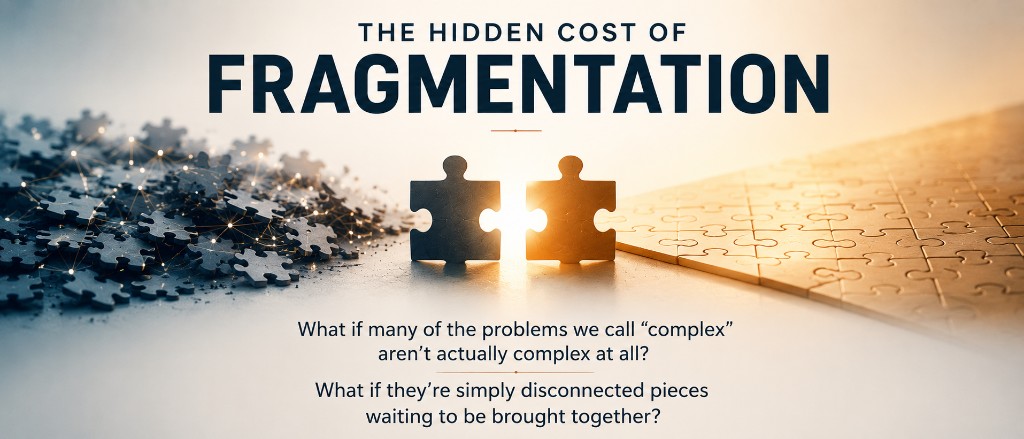
When the information exists but the connection breaks
Every day, millions of people spend time doing work that has already been done.
Not because the information doesn't exist.
But because they don't know it exists.
A customer explains the same issue to three different support executives.
An employee recreates a report that another team prepared last week.
A project team spends weeks building a dashboard, only to discover another team built the same one months ago.
Different problems.
Different industries.
The same pattern.
The information exists.
The expertise exists.
The technology exists.
Yet somewhere in between, the connection breaks.
At first, these look like separate problems.
Customer service.
Knowledge management.
Cross-functional collaboration.
But what if they're all manifestations of the same underlying issue?
And what if we've been calling that issue by the wrong name?
Complexity isn't always the real problem
For years, we have blamed complexity.
Organizations have become too large.
Processes have become too complicated.
Technology has become too difficult to manage.
But what if complexity isn't the real problem?
Think about a modern aircraft engine.
It contains thousands of interconnected components.
It is far more complex than a simple five-step approval process.
Yet it works with extraordinary precision because every component stays connected to the next.
Now think about that approval process.
Five teams.
Five handoffs.
Nothing technically difficult.
Yet every transition loses context.
The next person starts with less information than the previous one.
Work doesn't move forward.
It starts over.
The difference isn't complexity.
The difference is connection.
Fragmentation is the loss of context
I've started to believe that many organizations don't suffer from a complexity problem.
They suffer from fragmentation.
Fragmentation is not the absence of information.
It is the loss of context as work moves from one person, team, or system to another.
The pieces exist.
They simply don't work together.
And every disconnected handoff creates friction.
The cost we pay every day
The cost of fragmentation rarely appears on a balance sheet.
Yet we pay for it every day.
In repeated conversations.
In duplicate work.
In delayed decisions.
In poor customer experiences.
In lost trust.
Each moment seems insignificant.
Together, they consume enormous amounts of time, money, and human energy.
Perhaps the hidden cost of fragmentation isn't wasted effort.
It's wasted potential.
Connecting existing pieces
The more I observe businesses and digital products, the more I notice a common pattern.
Many successful platforms didn't create entirely new ecosystems.
They connected existing ones.
They reduced the friction between people, information, and services.
Their innovation wasn't simply about creating something new.
It was about helping existing pieces work together.
What this means for AI
I believe the same principle will shape the future of AI.
Its greatest contribution may not be generating more information.
It may be preserving context and connecting information that already exists but remains scattered across people and systems.
An AI system built on fragmented processes will simply automate fragmented decisions.
Technology amplifies the quality of the system it operates within.
If the underlying system is fragmented, automation simply scales fragmentation.
Ask a different question
The next time you encounter an inefficient process, pause before calling it complex.
Ask a different question.
Is this really a complexity problem?
Or is it a fragmentation problem?
Because once the fragments begin to connect, many seemingly complex problems suddenly become surprisingly simple.
Perhaps the hidden cost of fragmentation is that we mistake it for complexity.
Sometimes the most powerful solution isn't adding another piece. It's connecting the pieces that were already there.
Share this article
https://www.design-thinking.in/insights/the-hidden-cost-of-fragmentation