Artificial intelligence
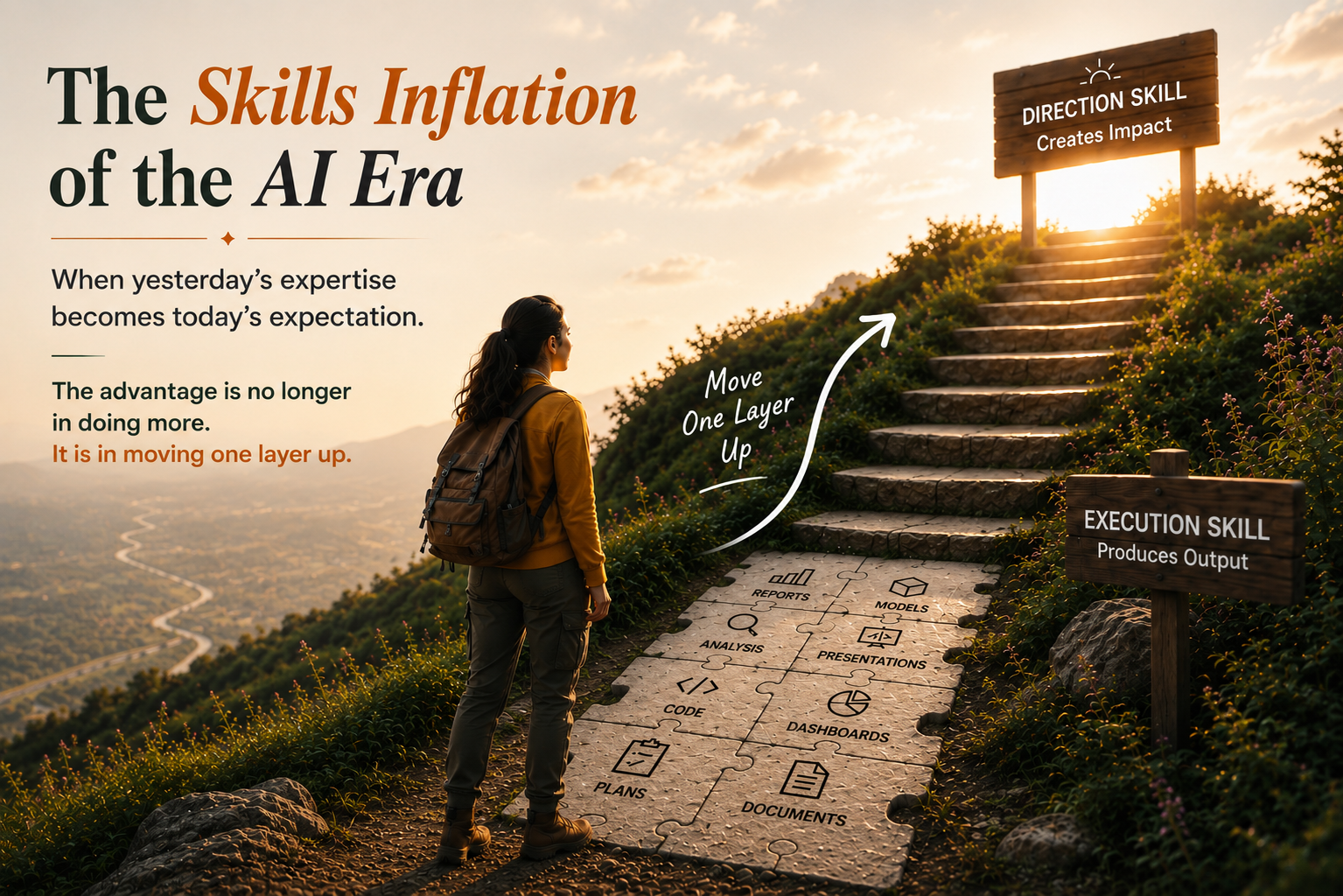
The Skills Inflation of the AI Era
When yesterday's expertise becomes today's expectation.
For many professionals, AI creates a strange tension. It is useful, powerful, and impossible to ignore. But it also raises an uncomfortable question: what happens when the skills we worked hard to master become easier for others to imitate at the surface level?
This article explores that shift - why it feels unsettling, why those skills are not wasted, and how professionals can move one layer up from producing output to shaping what truly matters.
Public Excitement, Private Discomfort
A lot of professionals are publicly excited about AI. Privately, many are unsettled.
Some will admit it. Most will not.
Because the fear is not always dramatic. It is not always about losing a job tomorrow. Sometimes it is quieter than that.
It is the uncomfortable realization that a skill you spent years building may no longer be as rare as it used to be.
Work that once required years of practice now feels easier to attempt. The blank page is less intimidating. The first draft arrives faster. A scattered set of inputs can become a structured note with less effort. A rough idea can become a presentable narrative with fewer iterations. What once separated a skilled professional from an average one is no longer as difficult to imitate at the surface level.
For people who never had those skills, this feels empowering. For people who spent years developing them, it can feel disorienting.
That is the part we do not discuss enough.
"AI is not only changing productivity. It is changing the emotional value of expertise."
Why This Feels Personal
I have felt this personally.
Narrative writing was one of my strengths. Over the years, I wrote many articles, proposals, business documents, strategy notes, and structured narratives. It was not a skill I picked up casually. It came through practice, feedback, failed drafts, better drafts, and the slow process of learning how to shape an idea clearly.
The same was true for many other skills I built over time - data analytics, strategic frameworks, product thinking, structured problem-solving, communication, and the ability to translate complexity into something people could act on.
These were not just workplace tasks. They were professional differentiators. They helped me think better, communicate better, influence better, and solve problems faster.
That is why the AI shift feels different. It is not only giving people a new tool to work faster. It is also changing the value of some of the capabilities we worked hard to master.
That is the shift I think many professionals are feeling, even if they are not calling it out openly.
Skills Inflation
I think of this as skills inflation.
In economics, inflation does not make money worthless. It reduces its purchasing power. The same amount of money buys less than it used to.
Something similar is happening with many professional skills.
Skills inflation is what happens when the relative value of skills diminish. A capability that once gave professionals an edge becomes easier for many others to access. Over time, the market stops treating it as exceptional and starts treating it as expected.
That does not make the skill worthless. It simply means the same skill no longer buys the same professional advantage.
A writer can still write better than AI. But writing well alone may no longer buy the same advantage.
An Excel expert can still understand models better than someone casually using AI. But formula knowledge alone may no longer buy the same advantage.
An analyst can still have strong analytical capability. But creating charts and summaries alone may no longer buy the same advantage.
A product or program manager can still create plans, documents, and reviews. But documentation alone may no longer buy the same advantage.
This is the real discomfort of skills inflation.
AI does not remove the value of skill.
It raises the minimum standard of skill.
And once the minimum standard rises, the differentiator must move one layer up.
The One Layer Up Framework
What does it mean to move one layer up?
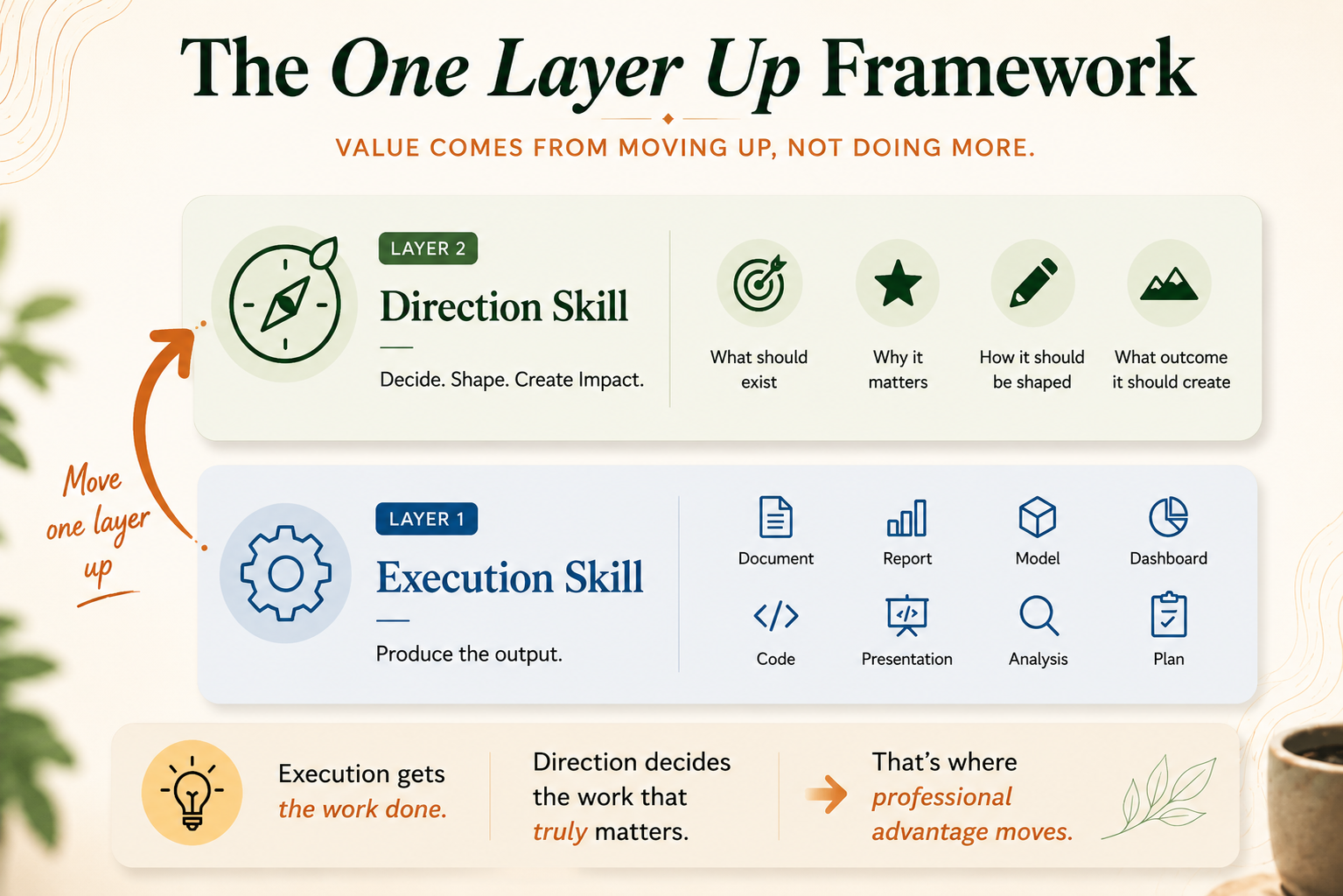
It means shifting from execution skill to direction skill.
Every professional skill has two layers.
Layer 1 is Execution Skill.
This is the ability to produce the output - a document, report, model, dashboard, piece of code, presentation, workflow, analysis, or plan.
Layer 2 is Direction Skill.
This is the ability to decide what output should exist, why it matters, how it should be shaped, what context it must account for, and what outcome it should create.
Before AI, Layer 1 often created differentiation. If you could write better, analyze faster, build sharper models, create cleaner slides, automate repetitive work, or produce reliable code, you had an edge.
In the AI era, Layer 1 is increasingly assisted, accelerated, or partially commoditized.
So, the professional advantage moves to Layer 2.
Not because execution skill has no value, but because execution skill alone is becoming less protective as a professional advantage.
The old skill becomes the foundation. The new advantage sits one layer above it.
A person who has actually written many narratives will usually have better narrative judgment than someone who only prompts AI. A person who has built models will usually judge AI-generated analysis better than someone who has never struggled with assumptions. A person who has worked across programs and products will usually know when a clean document is hiding unclear ownership, weak prioritization, or missing alignment.
"The old skill still matters. But its highest value now comes from the direction it enables."
Mapping Your Skill One Layer Up
Once the idea is clear, the next step is to apply it to your own work.
Take the skill that currently gives you confidence and ask:
What should this skill help me judge, shape, or decide?
A simple way to map it is this:
| Current strength | One layer up | What it means in practice |
|---|---|---|
| Writing | Narrative thinking | Move from writing better sentences to framing ideas, simplifying complexity, understanding audience resistance, and shaping decisions through words. |
| Advanced Excel | Business judgment | Move from building models to explaining assumptions, trade-offs, risks, and decisions. |
| Analytics | Sense-making | Move from reporting numbers to explaining what matters, why it matters, and what should happen next. |
| Coding | System design | Move from writing code to understanding architecture, scalability, reliability, security, and product logic. |
| Research | Question design | Move from collecting information to asking sharper questions and identifying what is missing. |
| Presentations | Influence | Move from making slides to changing how people understand, decide, or act. |
| Program management | Operating clarity | Move from tracking work to clarifying ownership, dependencies, decisions, and execution rhythm. |
| Product management | Problem framing | Move from managing features to defining the right problem, user value, trade-offs, and product direction. |
| Branding and communication | Meaning design | Move from creating messages to shaping perception, trust, recall, and strategic positioning. |
| People management | Talent judgment | Move from assigning work to developing people, reading capability, and creating conditions for performance. |
This table is not exhaustive. Every profession will have its own version.
The current strength remains useful. But its future value depends on whether it helps you judge better, shape better, or decide better.
That is the shift from execution skill to direction skill.
What Professionals Should Do Next
Skills inflation does not mean professionals should abandon the skills they worked hard to build.
It means they need to understand what those skills now have to become.
Once this shift is visible, the next step is personal.
Pick one skill that has given you an edge in your career.
Then complete this sentence:
"AI may make the output easier to create, but my deeper value is in ______."
If your answer is still the tool, the task, or the visible output, go one layer higher.
The point is not to abandon the skill. The point is to ask what it now enables.
Does it help you frame the problem better?
Does it help you judge the output better?
Does it help you shape the decision better?
Does it help others see what matters?
Does it help the system work with more clarity?
That is where the next version of your skill begins.
The years spent building skills are not wasted. They become the foundation. But in a period of skills inflation, the foundation alone may not be enough. It has to support judgment, direction, and impact.
AI has not ended the value of skill. It has ended the comfort of stopping at skill.
The professionals who stay ahead will not be the ones who only produce faster. They will be the ones who know what is worth producing, why it matters, how it should be shaped, and what outcome it should create.
"Skills inflation raises the baseline. Moving one layer up rebuilds the advantage."
Share this article
https://www.design-thinking.in/insights/the-skills-inflation-of-the-ai-era