
Define
Introduction - Define
Phase 2: Define
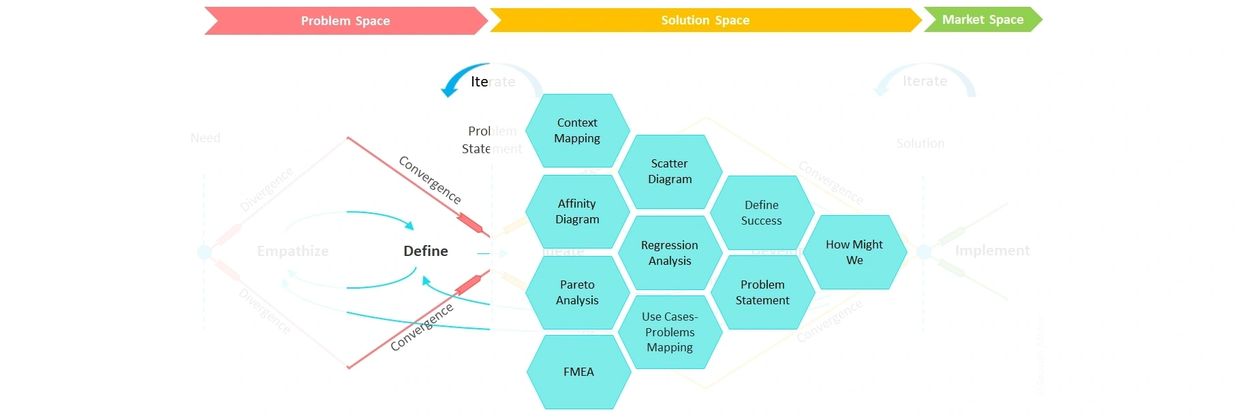
'Define' phase of Design Thinking is all about analysis of data and information collected during Empathize phase and narrowing the number of problems down to actionable Problem statement(s).
Define phase uses multiple processes and tools, in order to systematically analyze data and information about the problems (possible root causes of user's pain points) :
1. Context Mapping: We start with categorizing problems based on their contexts and business stakeholders involved.
2. Affinity Diagram: The problems in each context are categorized into clusters based on their similarity.
3. Pareto Analysis: The data gathered for each of the problems are analyzed for its significance to the user's observed pain points.
4. FMEA: The significance of the problems are also measured in terms of its Occurrence, Severity, and Detection possibilities.
5. Scatter Diagram: We reject some problems from the list of possible root cause of user's pain points, due to their poor correlation with the pain points.
6. Regression Analysis: In some data intensive problem scenarios, we do statistical analysis of data to establish correlation between various factors, and narrow down the problems to the ones with strongest correlation to the user's pain point.
7. Use Case-Problem Mapping: Based on the above analyses, we map the problems against each Use cases (where user's pain points are observed).
8. Define Success: For each of the Use case, we define the success metric (the desired state of users)
9. Problem Statement(s): We try to converge all the use cases in one problem statement. However, in some cases, we might end up with 2-3 problem statements (more than 3 Problem Statements are not recommended)
10. How Might We: The problem statements are converted into How Might We questions, to trigger thought for solution phase.