
Empathize
Interview for Empathy
Interview for Empathy

Empathy interviews are one-on-one conversations with users that help gain more information on the their needs (pain points) and uncover unacknowledged needs.
According to Stanford d.school, there are three ways - Observe, Engage, Immerse (OEI), to gain deeper empathy to understand the users and their real needs:
1. Observe: Observe Users and their behavior in their natural environment gives us clues about what they think, feel and need.
2. Engage: Interact with and interview users with open-ended question. Elicit further responses by asking "Why" questions, to get to the root of the problem or become aware of the problems that we never knew existed.
3. Immerse: Experience what users experience. Be in their shoes. See from their eyes. Get into the user's environment and go through the user's journey by self, to gather first-hand understanding of the problems user is experiencing.
Empathy Map
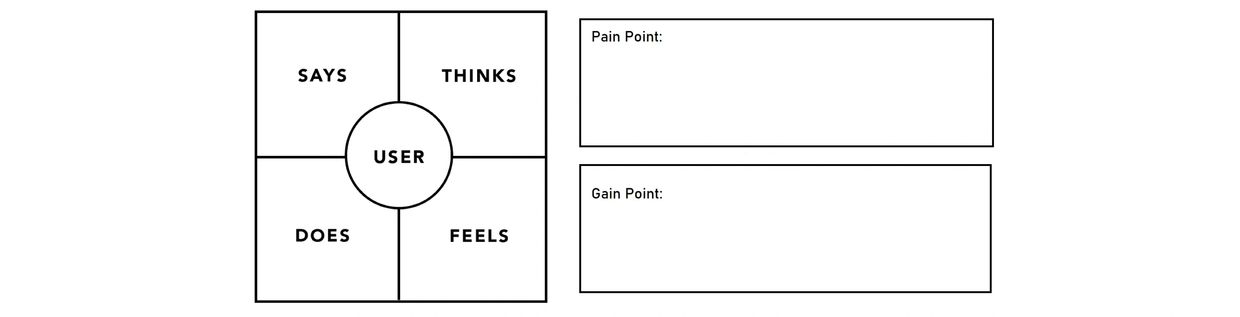
An empathy map is the outcome of all the empathy interviews, we had with our users. It is a simple visual that captures knowledge about the user’s behaviors and attitudes.
The Empathy Map is divided into 6 different categories:
1. What do they say ? This quadrant contains what the user say out loud in the interviews and interactions.
2. What do they do ? This quadrant captures information about the physical actions of users or stakeholders in a particular user environment.
3. What do they think ? This quadrant captures what the user thinks throughout the experience, but may not be willing or able to articulate it clearly.
4. What do they feel ? This quadrant is the user’s emotional state e.g. annoyed, confused, angry, happy etc.
5. What are their Pain points in the entire user journey ? Based on the above inputs on what the user/stakeholder say, do, think and feel, we summarize the pain points/problems of users and stakeholders.
6. What are their potential Gain points in the entire user journey ? What would have made them happy ? Expected state of process ? What is the desire state of the user environment after implementation of solution ?